

Human Rights Management System
Human Rights and Labor Policy
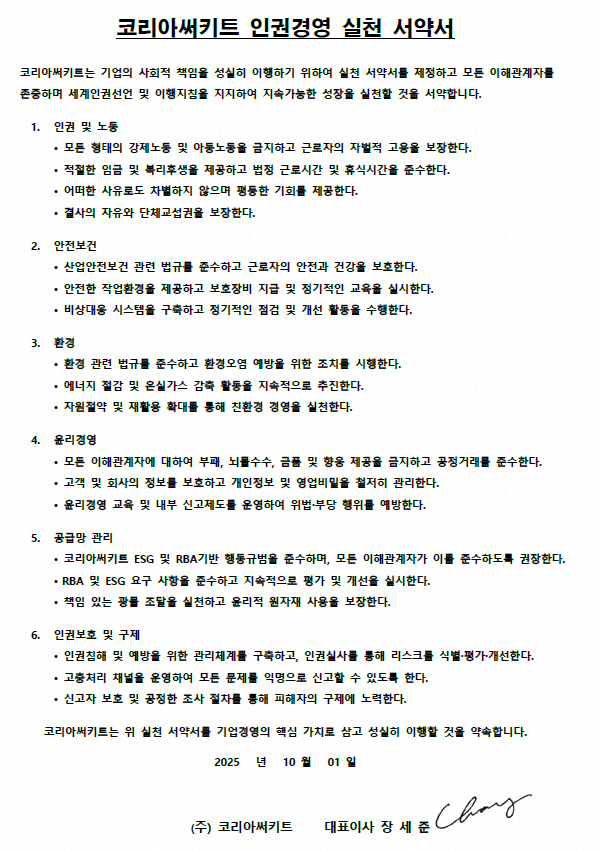
Korea Circuit has established a Human Rights and Labor Policy to create a management environment where the dignity and rights of all employees and stakeholders are respected, operating it as the fundamental principle of company-wide human rights management. The policy is based on international and domestic human rights and labor standards, including key conventions of the International Labour Organization (ILO), the United Nations Global Compact (UNGC), national labor-related laws, and the Responsible Business Alliance (RBA) Code of Conduct. It includes responsible labor practices such as the prohibition of forced and child labor, prevention of discrimination, assurance of fair working conditions, and respect for freedom of association. In 2025, to clarify the management's responsibility and commitment to human rights management, a Human Rights Management Pledge was established in the name of the CEO. This formalizes the principles of responsible management, including human rights and labor, safety and health, environment, ethical management, supply chain management, and remedies for human rights violations, as core values of corporate management. It also publicly declares the intention to respect all stakeholders and support international human rights standards. Additionally, Korea Circuit has established and published the Korea Circuit Code of Conduct based on the RBA Code of Conduct to educate employees on core labor principles through management activities. We will continue to enhance related systems and implementation frameworks so that human rights management principles are practically integrated into business operations and organizational culture.


Long-term Goals for Human Rights Management
Korea Circuit has established step-by-step long-term goals to ensure that human rights management is not just a one-time declaration but is substantially integrated into overall business operations. From the initial stage of laying the foundation for the human rights management system to enhancing human rights risk management across the supply chain and establishing a globally aligned human rights management system, we intend to systematically implement these goals through the detailed annual direction and key tasks. In the short term, we will focus on establishing the human rights management process and constructing a management system for workplace human rights risks. In the medium term, we plan to expand the application scope of human rights management through regular assessments of supply chain risks and improvements with high-risk partners. In the long term, by building a response system that meets the international standards and global customers, and continually enhancing human rights impact assessments and supply chain human rights management, we aim to secure capabilities for human rights management at a global level. Korea Circuit will continuously check the implementation status of these long-term goals and derive improvement tasks to strengthen a responsible management system that respects the human rights of all stakeholders, including employees, partners, and the local community.

Human Rights Management Activity
Grievance Handling
Korea Circuit operates grievance counseling and reporting channels to prevent and address human rights violations and unfair treatment within the organization. These channels allow anyone to consult or report various issues such as work complaints, organizational culture problems, workplace harassment, sexual harassment, discrimination, and human rights violations. All submissions are handled with anonymity, confidentiality, and security, and processed promptly and fairly. The actual operation achieves a 100% resolution rate annually, contributing to the protection of member rights and the enhancement of organizational trust.
Grievance Handling Process

Grievance Reporting Channel
Grievance Handling Status
(Unit: Cases)
Year | 2023 | 2024 | 2025 |
|---|---|---|---|
Grievance Occurred | 7 | 12 | 9 |
Grievance Resolved | 7 | 12 | 9 |
Resolution Rate | 100% | 100% | 100% |
* Including internal partners
Human Rights Risk Assessment
Korea Circuit conducts an annual human rights risk assessment across all business sites. This assessment proactively identifies human and labor-related risk factors that may arise during business operations and systematically examines their impact on key stakeholders such as employees and partners. The evaluation incorporates internal operations, stakeholder feedback, and external assessment results to set priorities based on the severity and need for improvement of identified risks. Subsequently, we collaborate with relevant departments to establish and implement improvement tasks, continuously monitoring the outcomes to enhance the effectiveness of human rights risk management. Korea Circuit will continue to conduct regular human rights risk assessments and improvement activities to prevent potential human rights violations, consistently strengthening a responsible human rights management system across all business operations and supply chains.
Human Rights Risk Assessment Process

Human Rights Risk Assessment Results
Risk Category | Risk Name | Improvement Actions | Status | |
|---|---|---|---|---|
Internal | Human Rights | Inadequate human rights management policy | Establishment of human rights management policy | Completed |
Labor | Inadequate working hours management | Introduction of working hours monitoring system | Completed | |
External | Human Rights | Unverified commitment of management to human rights management | Establishment of [Human Rights Management Pledge] | Completed |
Labor | Inadequate working hours management | Introduction of working hours monitoring system | Completed | |
Supply Chain Management | Lack of supply chain ESG evaluation | Establishment of partner code of conduct and implementation of supply chain ESG self-assessment | Completed | |
* Internal assessment led by: ESG Promotion Team, HR Support Team, Safety and Environment Team, etc.
* External assessment led by: RBA evaluation organizations, ISO evaluation organizations, client ESG evaluation managers, etc.
Operation of Labor-Management Council
Korea Circuit does not operate a separate labor union but actively utilizes the labor-management council, Hanmaum Council, as a major communication and consultation body between employees and management. The Hanmaum Council is an official committee where management and employee representatives participate to discuss key issues such as working conditions, wages, benefits, health and safety, organizational culture, and management status on a quarterly basis. The opinions and suggestions of employees gathered during consultations are thoroughly reviewed and reflected in the improvement of systems and working environments, and the status of agreements is continuously monitored. Through this, Korea Circuit aims to enhance mutual understanding and trust between labor and management, prevent internal conflicts, and continuously strengthen a cooperative labor-management culture where all members are respected and can grow together.
Operation Status of Hanmaum Council
Category | Quarter 1 (2025. 01. 18) | Quarter 2 (2025. 04. 23) | Quarter 3 (2025. 08.28) | Quarter 4 (2025. 10. 01) |
|---|---|---|---|---|
Key Topics | ㆍWage increase negotiations for hourly employees (by position /grade) | ㆍSalary adjustment negotiations for managerial staff (annual salary system) | ㆍDiscussions on concurrent operation of retirement pension (DC) | ㆍNegotiations on work schedule during Chuseok holidays |
ㆍNegotiations on Seol special incentive payments | ㆍ2nd quarter business environment briefing | ㆍNegotiations on plans for community contribution activities | ㆍ4th quarter business environment briefing |