

Strengthening Supply Chain Management
Policy and Guideline
Korea Circuit has established a Supplier Code of Conduct to promote sustainable co-prosperity with our partners, ensuring compliance with product quality, distribution management, legal requirements, and ethical standards related to social responsibility. This code is publicly available on the sustainability management section of the Korea Circuit website for all partner company personnel to access. Based on the Responsible Business Alliance (RBA) Code of Conduct, it encompasses five areas: labor rights, safety and health, environment, ethics, and management systems. The Code applies to all partner companies and is included as a mandatory compliance clause in supplier contracts. New partners must submit a compliance agreement to enhance the effectiveness of supply chain management.
Partner ESG Self-Assessment
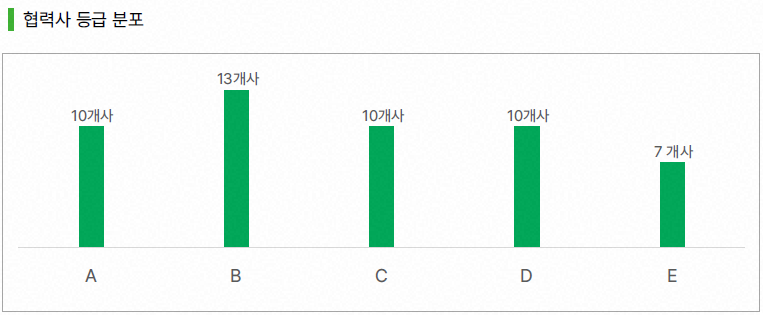
Korea Circuit conducts an [ESG Self-Assessment for Partners] annually in the second half of the year, following the process outlined below. In the 2025 assessment, a total of 50 primary partners participated, and the distribution of partner ratings is as follows: closer to grade A indicates higher sustainability, while closer to grade E indicates critical sustainability issues. In the future, Korea Circuit plans to conduct on-site evaluations for supply chains rated at a critical level (grade E) based on the self-assessment results. Additionally, they will plan ESG education and support initiatives to further strengthen the ESG management system of their supply chain.
Partner ESG Self-Assessment Process

Responsible Minerals
Responsible Minerals refer to minerals that are mined and sourced through ethical and transparent supply chains from areas not associated with funding armed groups, human rights abuses, or environmental destruction. The primary minerals include 3TG (Gold, Tin, Tungsten, Tantalum) and Cobalt, often referred to as Conflict Minerals, which are essential in various manufacturing processes, including the electronics and machinery industries. The U.S. government has implemented regulations to curtail the utilization of minerals mined in the Democratic Republic of the Congo (DRC) and its nine adjacent countries, as they may fund armed groups. Consequently, the U.S. Securities and Exchange Commission (SEC) mandates publicly listed companies to investigate the origin of such minerals used in their products and disclose the information transparently. Korea Circuit collaborates with suppliers to strengthen the transparency and accountability of our supply chain and establish a sustainable mineral sourcing system in alignment with these international regulations and ethical responsibilities.
Responsible Minerals Policy and Management
Korea Circuit has established and actively implemented a responsible minerals procurement policy that aligns with global ethical standards, contributing to the construction of an ethical and sustainable supply chain. To prevent the use of minerals sourced from conflict-affected and high-risk areas, we regularly verify the responsible use of minerals by our suppliers and systematically manage related reports. Korea Circuit requests its suppliers to submit international standard forms, such as the CMRT (Conflict Minerals Reporting Template) and EMRT (Extended Minerals Reporting Template) as suggested by the Responsible Minerals Initiative (RMI). These forms are made accessible on the Korea Circuit website to facilitate easy access and use by partners. Moving forward, Korea Circuit is committed to expanding responsible mineral sourcing activities, enhancing transparency and accountability across the supply chain, and developing systems that meet the demands of global stakeholders.