

Climate Change Scenario
Korea Circuit has developed a long-term climate change scenario to establish and review the implementation of its 2050 carbon neutrality goal.
This scenario has been analyzed in three phases (High, Medium, Low) to assess the risks of climate change and examine response strategies.
Risk Category | Reason | Financial Impact | Duration | Response Strategy |
|---|---|---|---|---|
Pollutant Emission Reduction | ㆍStrengthening standards for environmental pollutant management ㆍIncreasing demand for eco-friendly production from customers | High | Short Term | ㆍExpanding waste recycling and improving treatment efficiency ㆍStrengthening activities to replace and reduce hazardous chemical emissions ㆍTransitioning to eco-friendly raw materials and processes ㆍResponding to eco-friendly certifications and global initiatives |
Climate Change Risk Management | ㆍIncrease in greenhouse gas burdens ㆍStrengthening energy and greenhouse gas management ㆍIncreasing risk of natural disasters | High | Long Term | ㆍAnalyzing and strategizing for *emissions trading cost ㆍPromoting greenhouse gas reduction and high-efficiency equipment investment ㆍOperating energy efficiency task force and managing based on FEMS ㆍEstablishing management systems for Scope 1, 2, and 3 emissions ㆍDeveloping renewable energy transition strategies ㆍOperating monitoring and response systems for natural disasters ㆍConducting facility inspections and emergency response drills |
Biodiversity Conservation Efforts | ㆍDamages to biodiversity and ecosystem changes | High | Long Term | ㆍAnalyzing and managing environmental impact on surrounding business areas ㆍPromoting environmental purification and ecological preservation activities |
*emissions trading cost: Estimated average amount of 15,000 KRW in 2025
Climate Change Risk
Greenhouse Gas Management
Korea Circuit is committed to participating in the international climate goal of limiting the increase in global average temperature to within 1.5°C above pre-industrial levels. Accordingly, it has set the long-term goal of achieving Net-Zero by 2050, and is pursuing company-wide reduction activities to cut Scope 1 and 2 greenhouse gas emissions by 65.5% within ten years based on 2025 levels. Key reduction strategies include converting old facilities to high-efficiency facilities, expanding energy efficiency projects, applying eco-friendly chemicals, and improving production processes to reduce direct emissions. Additionally, the company is considering expanding the introduction of renewable energy PPA and establishing carbon-neutral certification systems to gradually reduce indirect emissions and strengthen the low-carbon transition foundation across the business.
In September 2025, Korea Circuit officially announced its commitment to join the SBTi (Science Based Targets initiative), a global initiative that scientifically verifies corporate greenhouse gas reduction targets, and is working on refining the calculation of Scope 1 and 2 greenhouse gas emissions, as well as calculating and analyzing key emission sources of Scope 3 emissions to establish Near-term (within 10 years from the base year) Targets. Furthermore, by continuously responding to CDP and reviewing participation in global climate initiatives such as RE100, the company aims to enhance transparency in greenhouse gas reduction and international credibility.
Meanwhile, Korea Circuit is proactively addressing the financial risks associated with carbon pricing and increasing greenhouse gas-related costs. The company is continuously reducing energy consumption and greenhouse gas emissions by replacing old facilities within processes with high-efficiency facilities and operating a dedicated task force for energy consumption reduction. It is also preparing for the 4th phase of the emissions trading scheme by analyzing financial impacts based on carbon pricing scenarios and establishing phased response strategies. Korea Circuit will strengthen its data-based greenhouse gas management capabilities to systematically respond to climate change-related risks and opportunities, and faithfully implement mid- to long-term carbon neutrality goals.
Greenhouse Gas Emission Status
(Unit: tCO2eq)
Categoty | 2023 | 2024 | 2025 |
|---|---|---|---|
Scope 1 | 4,528 | 3,374 | 5,510 |
Scope 2 | 121,656 | 127,973 | 133,380 |
Scope 3 | N/A | N/A | 379,230 |
Total | 126,184 | 131,347 | 518,120 |
(Unit: tCO2eq)
Scope 3 Detailed Emissions (by Category) | 2023 | 2024 | 2025 |
|---|---|---|---|
Purchased goods and services | N/A | N/A | 305,709 |
Capital goods | N/A | N/A | 3,860 |
Fuel and energy-related activities (not included in Scope 1 or 2) | N/A | N/A | 8,355 |
Upstream transportation and distribution | N/A | N/A | 2,805 |
Waste management | N/A | N/A | 21,505 |
Business travel | N/A | N/A | 319 |
Employee commuting | N/A | N/A | 18,079 |
Upstream leased assets | N/A | N/A | 50 |
Downstream transportation and distribution | N/A | N/A | 1,747 |
Processing of sold products | N/A | N/A | 15,667 |
Use of sold products | N/A | N/A | N/A |
End-of-life treatment of sold products | N/A | N/A | 1,117 |
Downstream leased assets | N/A | N/A | 14 |
Franchises | N/A | N/A | N/A |
Investments (GHG emissions from subsidiaries and associated investments) | N/A | N/A | 3 |
Total | N/A | N/A | 379,230 |
* Scope 3 calculations will begin in 2025 / No third-party verification undertaken.
Greenhouse Gas Emission Near-Term Strategy
Category | Short-Term(~2027) | Phase 2(~2030) | Phase 3(~2035) |
|---|---|---|---|
Strategic Direction | ㆍInfrastructure Building ㆍEstablishing energy transition foundations | ㆍProcuring renewable energy ㆍExpanding eco-friendly materials | ㆍCompleting a low-carbon supply chain ㆍAchieving near-term goals |
Scope 1 & 2 | #1. Installation of self-consumption solar power facilities (rooftop) | ㆍPurchase of RECs | ㆍGradual transition to PPA (#2. 65.5% reduction compared to 2025) |
Scope 3 | ㆍPreparing for the introduction of recycled metals (Cu, Au) | ㆍExpanding the introduction of recycled metals (Cu, Au) | ㆍIncreasing conversion of raw materials (30% reduction compared to 2025) |
#1. Greenhouse Gas Emission Reduction Item: Solar Power Installation
Plan | Capacity | Operating Time | 20-year Reduction Effect | |
|---|---|---|---|---|
Electricity | Carbon | |||
Solar power Installation | 953 kW | 3.4 hours/day | 23,652 MWh | 11,228 tCO₂eq |
#2. Long-term Greenhouse Gas Emission Goals
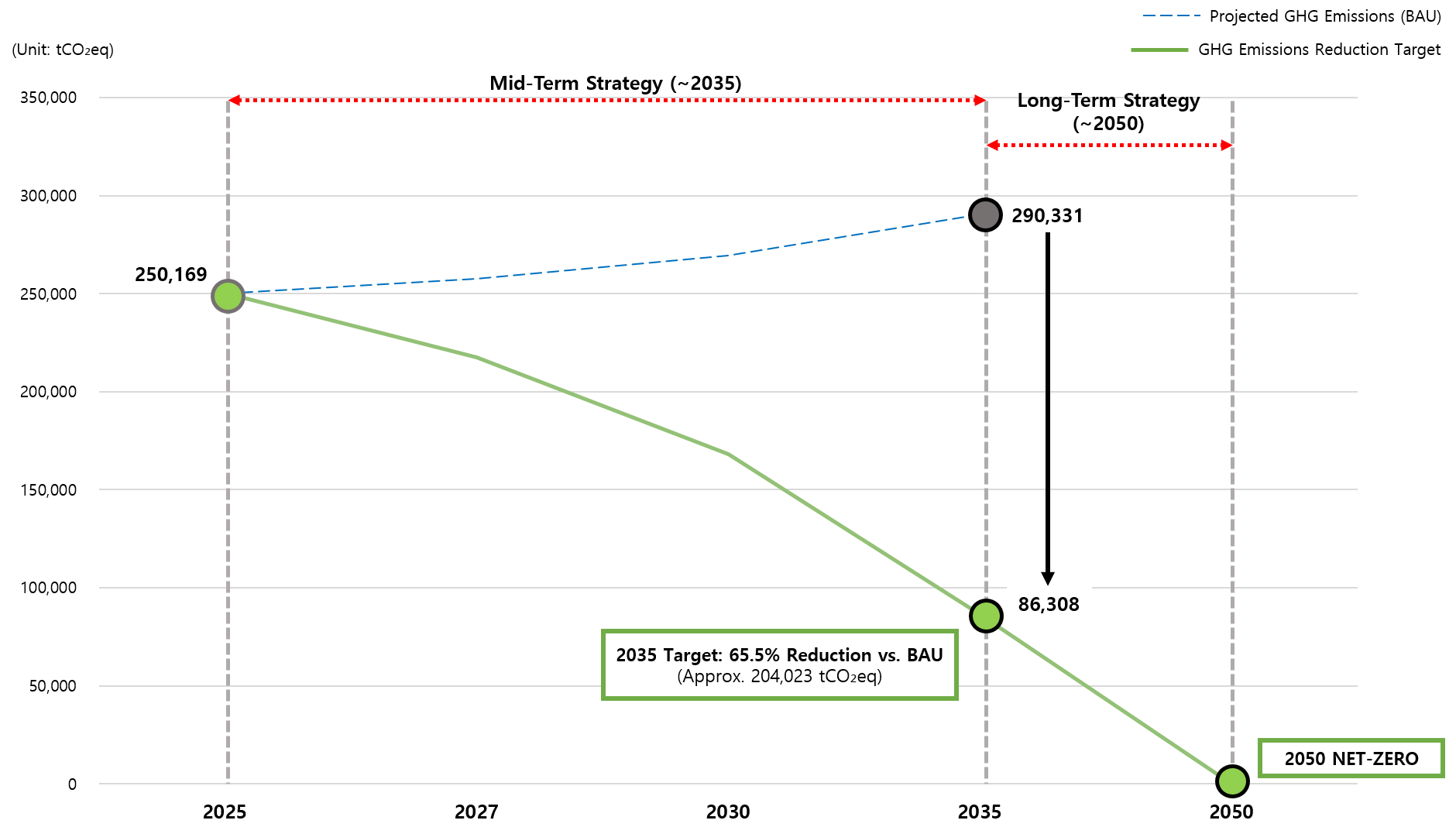
* Greenhouse Gas Emissions Projection (BAU): Assumes annual sales growth of 1.5%
Reduction of Pollutant Emissions
Strengthening Environmental Pollutant Management Standards
Korea Circuit has set internal management standards at a level below 30% of legal permissible limits to manage air and water pollutants more strictly during the operation of its facilities, and operates internal environmental management guidelines based on this. This is part of Korea Circuit's environmental management principle aimed not only at mere legal compliance but also at proactively preventing environmental risks and minimizing impacts on the local community and surrounding environment. Additionally, environmental measuring devices and real-time monitoring systems are applied throughout the production process to continuously check for pollutant emission statuses and abnormalities. If any irregularities are detected, causes are immediately analyzed, necessary corrective actions are taken, and efforts are made to continuously enhance management levels through regular on-site inspections and equipment improvements. Korea Circuit will continue to minimize the possibility of pollutant emissions and leaks based on strengthened internal standards and a prevention-centered management system, and advance a stable environment, health, and safety (EHS) management infrastructure.
Eco-Friendly Production
Korea Circuit is pursuing eco-friendly transition activities across the entire production process, from raw material procurement, in response to customer demands for eco-friendly production and strengthened global environmental standards, and to minimize environmental impact during the product manufacturing process. The standards and purchasing requirements for eco-friendly production are being expanded across the supply chain and shared with partners, and environmental risks are systematically managed from the raw material procurement stage by verifying whether raw material suppliers hold third-party and eco-friendly certifications.
To strengthen a resource-circulating production system, a portion of key raw materials like copper and gold is being replaced with recycled metals, and the purchase ratio of recycled raw materials and eco-friendly certified products is continuously being expanded. This reduces the environmental burden of new resource extraction and raw material production processes and promotes the efficient cyclical use of resources. In the production process, the usage of chemicals is continuously monitored, and hazardous chemicals are being converted into safer general chemicals or eco-friendly alternatives to reduce the types and total amount of substances handled. Furthermore, by optimizing process conditions and equipment operation methods, the cycle of preventive maintenance (PM) is extended, and the amount of chemicals used and waste generated during the maintenance process is minimized, thereby increasing resource efficiency throughout the process. Korea Circuit will continue to identify improvement tasks covering the entire process from raw material supply to chemical use and process operation, to enhance a responsible production system in line with customer demands and global environmental standards.
Climate Change Risk Management
Energy Management
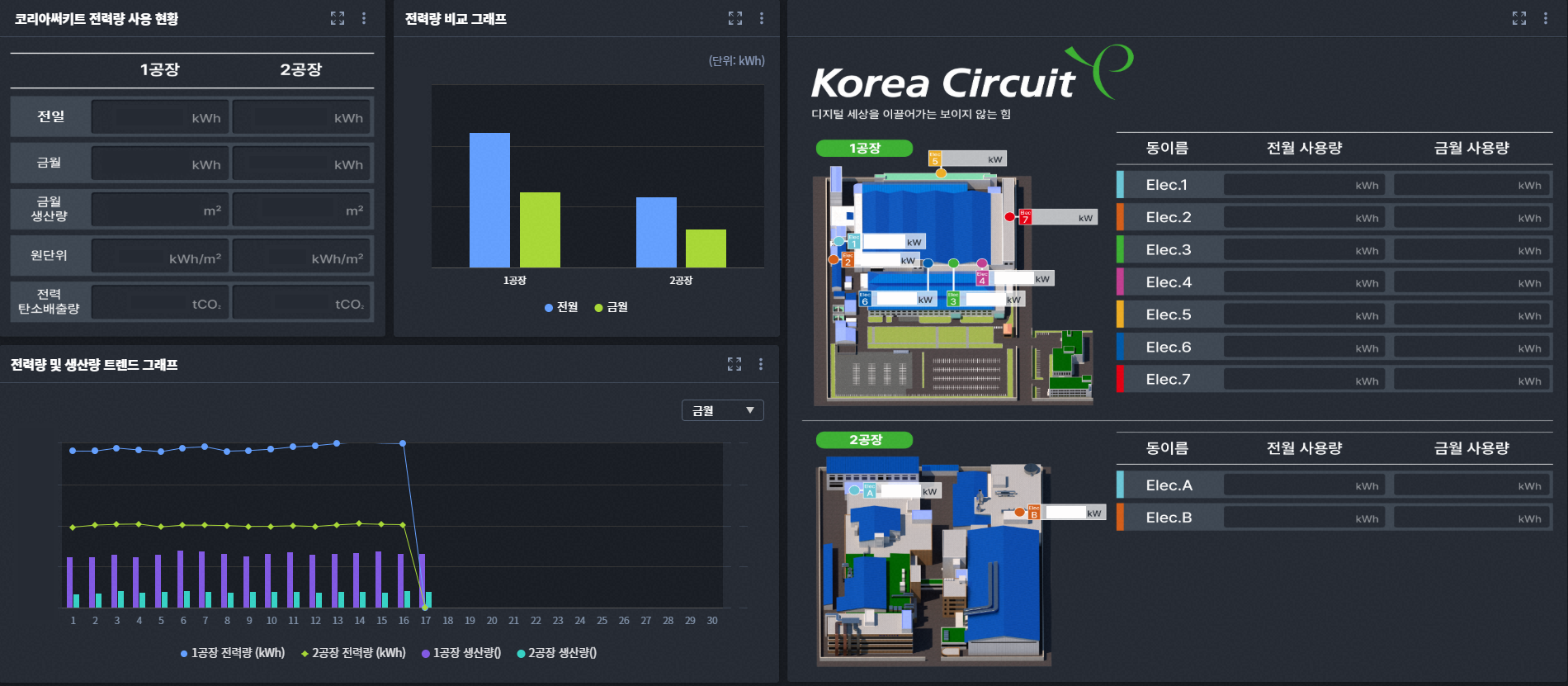
Korea Circuit is undertaking regular energy diagnostics and facility improvement activities to minimize energy loss and improve operational efficiency in production and support facilities. Utilizing FEMS(Facility Energy Management System), the company monitors energy usage of key facilities and processes in real time, analyzing usage trends and anomalies to identify energy-saving opportunities and enhance performance management. Utility facilities have reduced mechanical losses and power usage by replacing old blowers and repairing impellers with high-efficiency compressors. Cooling and heating systems maintain heat exchange efficiency and mitigate peak power loads in the summer by cleaning chillers, cooling towers, managing circulating water quality, and inspecting key components. Additionally, outdated fluorescent lights in factories and office buildings have been replaced with high-efficiency LED lighting to reduce continuous power consumption. Korea Circuit plans to continuously improve energy efficiency and greenhouse gas reduction across its operations by integrating FEMS-based data analysis with the transition to high-efficiency facilities.
Increase in Natural Disaster Risks
To prepare for physical risks due to climate change, Korea Circuit analyzes the impact of natural disasters on business operations using the Korea Meteorological Administration's national climate change standard scenarios SSP1-2.6 and SSP5-8.5, along with Munich Re's NATHAN program. The climate change scenario analysis shows that the number of heavy rain days in Danwon-gu, Ansan, Gyeonggi-do, is expected to increase from the current 2.2 days per year to a maximum of 3.1 days per year, leading to an increase of up to 0.9 days in localized heavy rain occurrences. In response, Korea Circuit has identified major physical risks such as overloading of drainage facilities due to torrential rain, building leaks, flooding of substation and production facilities, and operational disruptions of wastewater treatment facilities, which could potentially lead to business interruptions. It is estimated that the initial direct losses could amount to hundreds of millions of won due to disruptions in power supply and production facilities, leading to waste of in-process products. This estimate does not include sales and opportunity losses, equipment damage and repair costs, and additional costs due to customer delivery delays, so the actual financial impact could be more significant if the operation is halted for a prolonged period.
To minimize these risks, Korea Circuit conducts preventive maintenance activities including inspections of drainage and stormwater pipes, safety diagnostics and waterproof repairs of buildings, checks on flood risks to substations and key power facilities, and verification of emergency power supply systems. Additionally, the company regularly conducts emergency response drills to ensure rapid response and minimize damage during natural disasters. Moving forward, Korea Circuit will continue to monitor the level of natural disaster risks and the impact on business sites according to climate change scenarios, strengthening mitigation measures based on analysis results to ensure business continuity.

Biodiversity Conservation
Biodiversity Analysis
Korea Circuit is located in the Ansan Banwol National Industrial Complex, where no protected areas or endangered species have been identified within a 2km radius. To protect the environment, the company has established a buffer zone of 20km to identify protected areas and, based on analysis results, is implementing biodiversity conservation activities and developing medium- to long-term strategies as follows.


Biodiversity Conservation Activities
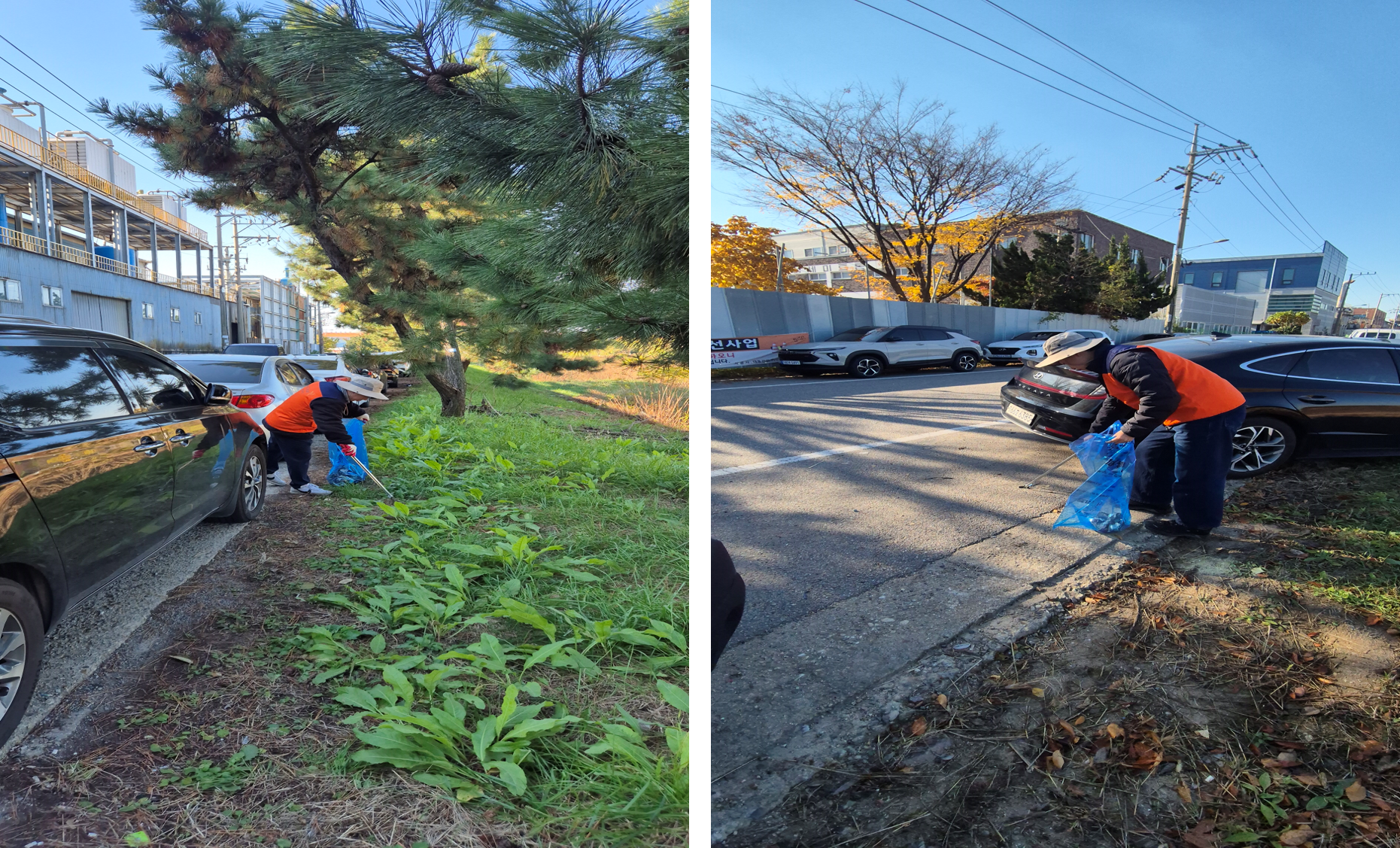
As part of a strategic approach to biodiversity conservation, Korea Circuit analyzes the status of endangered species and habitats in Ansan and Siheung and plans and carries out activities to protect them. Specifically, as part of the "Beautiful Industrial Complex" campaign, the company regularly conducts environmental clean-up activities along the Singil Stream on the second Friday of every month, which helps prevent water pollution from inflowing into Sihwa Lake and contributes significantly to restoring the health of the local ecosystem. The Ansan Reed Wetland, located at the uppermost stream of Sihwa Lake, is home to various species including the Class 2 endangered red-footed crab and Class 1 otters and spoonbills, underscoring the importance of protection. The company plans to establish and implement 'Medium- to Long-term Biodiversity Conservation Goals and Roadmap (2026–2035)' to further systematize and enhance biodiversity management from a comprehensive and long-term perspective.
Medium- to Long-term Biodiversity Goals
Category | Phase 1(~2027) | Phase 2(~2030) | Phase 3(~2035) |
|---|---|---|---|
Goal Type | ㆍInitiation and Establishment | ㆍStrengthening Practice and Capacity | ㆍContinuity and External Collaboration |
Main Direction | ㆍIdentifying the status of local ecological environments and systematizing regular conservation activities | ㆍStrengthen ecological impact reduction and self-management capabilities centered on Singil Stream | ㆍBuild external collaboration systems with local governments and environmental organizations |
Key Task | ㆍConduct Singil Stream clean-up activities at least once a month ㆍEstablish a system to manage cumulative employee participation ㆍManage indicators to minimize internal ecological impact | ㆍConduct annual self-ecological monitoring of Singil Stream ㆍPublish reports on the status of species around the business site ㆍActively participate in joint clean-up activities led by industrial complexes | ㆍRegularly participate in ecological conservation activities connected with Singil Stream and Sihwa Lake, at least once a year ㆍEngage in long-term local ecosystem monitoring with local governments and environmental organizations ㆍCooperate with relevant institutions for maintaining the ecosystem of Sihwa Lake |
Performance Aim | ㆍEstablish a foundation for preventing ecological pollution and environmental purification | ㆍSecure data and realize ecological impact reduction | ㆍContribute to the health recovery of Sihwa Lake and local ecosystem |